
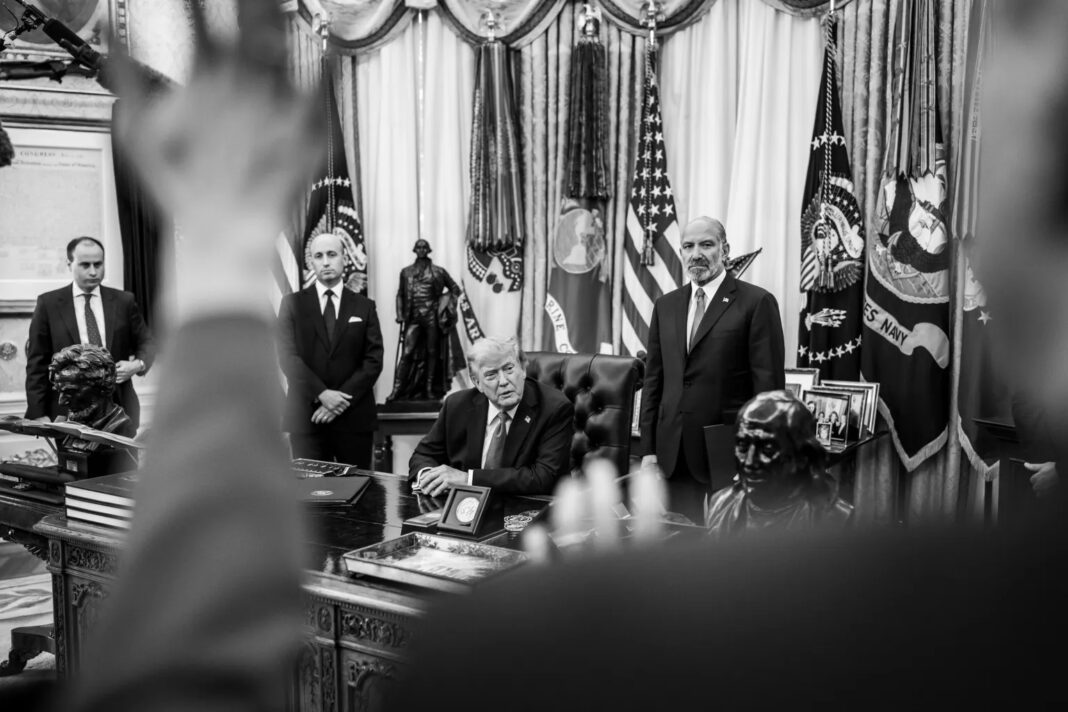
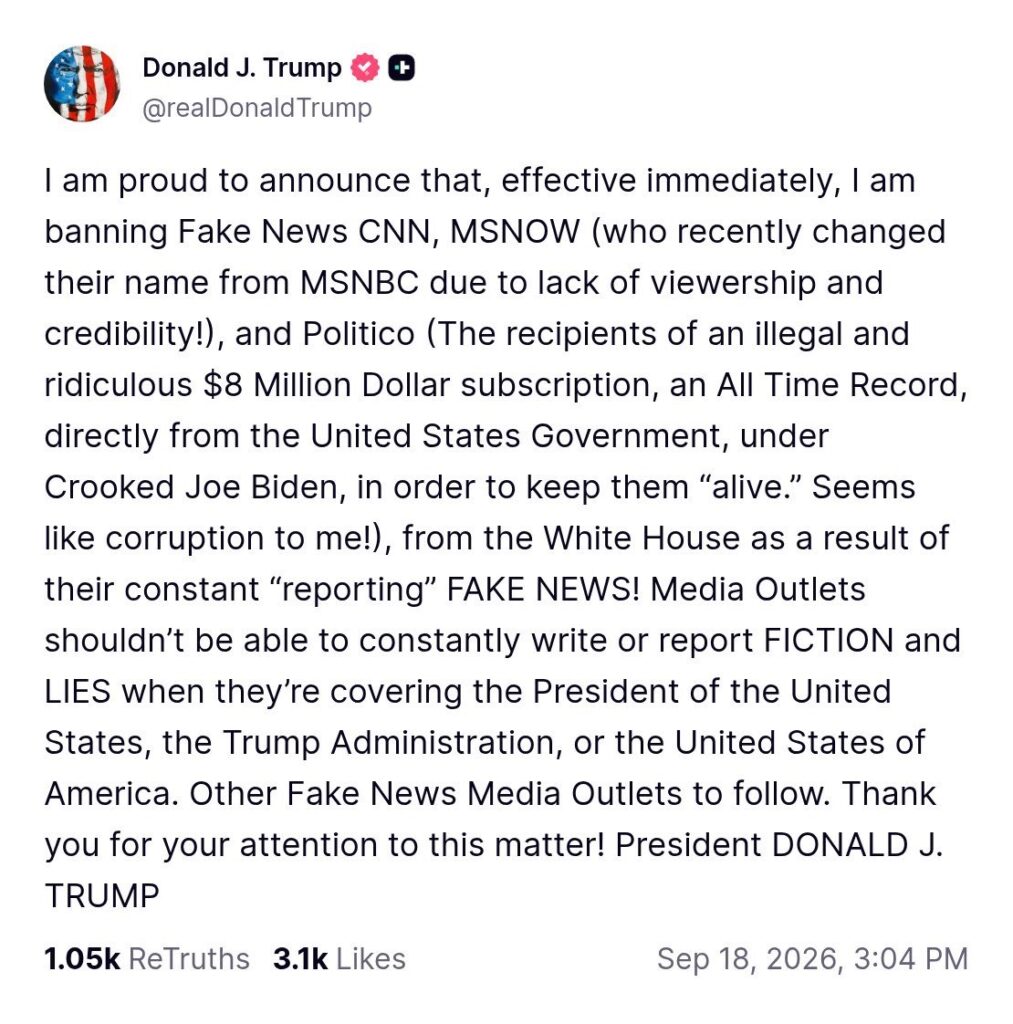
President Donald Trump said Friday he is banning CNN, MS NOW and Politico from the White House “effective immediately,” citing what he described as their constant reporting of “fake news,” “fiction and lies.”
In a Truth Social post, Trump wrote that the outlets should not be able to “constantly write or report FICTION and LIES when they’re covering the President of the United States, the Trump Administration, or the United States of America.” He added that “Other Fake News Media Outlets to follow.” The post offered no specific examples of reporting that prompted the announcement.
As of Friday afternoon reports, journalists from the named outlets remained on White House grounds with no immediate signs of eviction or enforcement details from the administration. The White House and the outlets did not provide immediate public comment clarifying the scope, such as whether it covers credentials, briefings, the press pool, Oval Office access or Air Force One.
MS NOW is the rebranded name of the former MSNBC network, adopted in late 2025 after a corporate spinoff that separated it from NBC News branding.
Is a ban like this allowed?
The First Amendment protects freedom of the press. Courts have long held that the government cannot exclude journalists from otherwise open access based on the viewpoint or content of their coverage. Once the White House grants media access to events or spaces (such as the press pool for limited-capacity settings like the Oval Office or Air Force One), selective exclusion on viewpoint grounds raises serious constitutional problems.
Legal experts have described similar past efforts as violating the First Amendment. Jameel Jaffer of the Knight First Amendment Institute at Columbia University stated that expelling organizations from the White House press pool on the basis of their viewpoints would be unconstitutional, noting the pool functions as a public forum in relevant respects. Due process considerations also apply to any revocation of credentials: clear, neutral criteria and an opportunity to challenge are generally required.
Access is not an absolute right. Presidents control who receives one-on-one interviews or special invitations, and space constraints have always limited participation. Viewpoint-based exclusion of established outlets from generally available coverage, however, has repeatedly faced successful court challenges. This remains a federal constitutional question that applies nationwide, including in Ohio. No state law alters the First Amendment analysis here.
Any formal implementation would almost certainly face rapid legal challenges from the outlets and press freedom organizations.
Has this happened before?
Yes, though usually on a narrower scale. During Trump’s first term, the White House revoked CNN correspondent Jim Acosta’s hard pass after a contentious 2018 press conference exchange. A federal judge ordered the credential restored.
In 2025, early in the current term, the administration restricted Associated Press access to the Oval Office, Air Force One and certain pool events after the AP declined to adopt the preferred name “Gulf of America” for the Gulf of Mexico. A federal judge ruled the practice contrary to the First Amendment because it constituted viewpoint discrimination; the case has continued in litigation with partial ongoing access for some AP personnel.
Broader historical tensions exist. Administrations from both parties have limited access, excluded specific reporters from events, or expressed frustration with coverage. Full organizational bans of this announced scope remain rare and have drawn swift pushback when attempted. The White House Correspondents’ Association has traditionally managed pool rotations; the current administration has asserted greater control over pool composition.
What supporters and critics are saying
Critics, including First Amendment lawyers and press advocates, frame the announcement as an escalation that tests constitutional limits and risks chilling independent coverage. They point to the Acosta restoration and the AP ruling as establishing that the government cannot punish outlets for disfavored reporting by denying access available to others. Organizations representing journalists have historically condemned such moves as undermining the public’s ability to receive independent information about the presidency.
Supporters of the president’s approach argue that White House access is a privilege, not an entitlement, and that persistent inaccurate or hostile coverage justifies limiting it. They view the action as consistent with Trump’s long-standing criticism of certain outlets as “fake news” and as a response to what they see as biased reporting. The administration has previously emphasized expanding access for newer or alternative media voices alongside traditional ones.
As of the latest reports, formal responses from CNN, MS NOW, Politico and the White House Correspondents’ Association were not yet available. Implementation details, any immediate court filings, and further administration clarification will shape the next developments.
This remains a developing story. The core legal principles turn on viewpoint neutrality under the First Amendment rather than on any single president’s preferences. Accurate public information about government actions depends on independent reporting, while presidents retain substantial control over their own communications and limited-space events.