
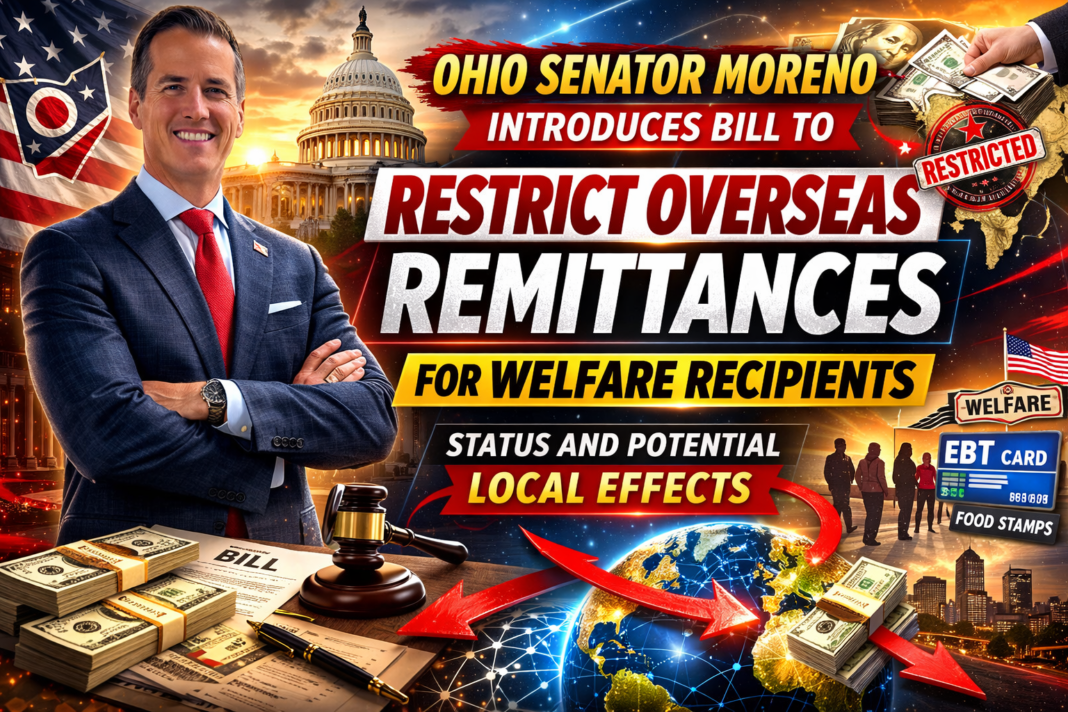
In a move sparking debate over welfare reform and immigration ties, U.S. Senator Bernie Moreno (R-Ohio) has introduced legislation that could prohibit individuals receiving federal public assistance from sending money abroad. The proposal, known as the Stopping Transfers of Public Funds Abroad Act (S.3746), targets what Moreno describes as potential abuse of taxpayer-funded benefits. As residents in south central Ohio grapple with economic challenges, including access to public assistance programs, this bill could affect thousands of families with international connections.
Bill Status: Introduced and Referred to Committee
The bill was formally introduced on January 29, 2026, and referred to the Senate Finance Committee, according to records from Congress.gov. Moreno addressed the Senate floor on February 25, 2026, requesting unanimous consent for the measure, but it has not advanced beyond committee referral. As of February 25, 2026, the legislation has no cosponsors and remains in the early stages of consideration.
The act would require applicants for federal benefits to sign a declaration under penalty of perjury, pledging not to engage in remittance transfers while receiving aid. Violators could face a $100,000 fine. Provisions would take effect 30 days after enactment, if passed. Moreno’s office stated the goal is to protect American taxpayers, emphasizing that “if an individual has enough cash to send money overseas, they have no business taking welfare benefits from hardworking Americans.”
The legislation applies to needs-based federal programs, including Supplemental Security Income (SSI) and similar assistance under Social Security regulations. It defines remittances as electronic fund transfers to individuals or businesses in foreign countries, a practice often used by immigrant families to support relatives abroad.
Potential Impact on Ohio Residents
While the bill is federal in scope, its effects could resonate strongly in Ohio, where public assistance programs support a significant portion of the population. In fiscal year 2025, an average of 1.44 million Ohioans – about 12.1% of the state’s population – received benefits through the Supplemental Nutrition Assistance Program (SNAP), according to data from USAFacts. For SSI specifically, Ohio had approximately 289,547 recipients as of May 2025, based on Social Security Administration statistics.
The policy could disproportionately affect Ohio’s foreign-born residents, many of whom maintain financial links to family overseas. Ohio’s immigrant population has grown, contributing to areas like Columbus, where foreign-born individuals drive population increases and participate in the labor force at rates higher than U.S.-born residents (about 70% versus 67%). In northeast Ohio alone, new Americans play a key role in the economy, though exact statewide figures on welfare participation among foreign-born individuals are limited.
Critics argue the bill may hinder legal immigrants who qualify for benefits after a five-year waiting period, potentially disrupting support for families in home countries. In south central Ohio counties like Ross, Pickaway, and Fayette, where SNAP usage supports rural families facing economic pressures, any restrictions could add strain. For instance, Butler County reported over 40,000 SNAP recipients in September 2025, with an average monthly benefit of $166.61.
Exact numbers on how many Ohio welfare recipients send remittances are not readily available from state or federal sources. However, national trends show remittances as a common practice among immigrant households, with the U.S. seeing outflows of around $150 billion annually. In Ohio, foreign-born individuals, including undocumented immigrants, contribute significantly to taxes – an estimated $332.4 million in state and local taxes in recent data – underscoring their economic role.
Broader Context in Ohio Politics
This proposal aligns with ongoing discussions in Ohio about immigration and public funds. State lawmakers have explored related measures, such as fees on remittances to combat drug trafficking, though none directly mirror Moreno’s bill. Eligibility for SNAP in Ohio requires U.S. citizenship or qualified non-citizen status, with rules barring many recent immigrants, per Ohio Administrative Code.
As the bill progresses, or stalls, in committee, south central Ohio communities will watch closely. Residents relying on programs like SSI or SNAP should consult local Job and Family Services offices for guidance on current rules. For more on Ohio welfare policies and their local effects, visit our site for updates.