
In a landmark decision on February 20, 2026, the United States Supreme Court struck down the sweeping tariffs imposed by President Donald Trump, declaring them unconstitutional under the International Emergency Economic Powers Act (IEEPA). The 6-3 ruling, authored by Chief Justice John Roberts, represents a significant rebuke to one of the president’s core economic policies. Justices Clarence Thomas, Samuel Alito, and Brett Kavanaugh dissented.
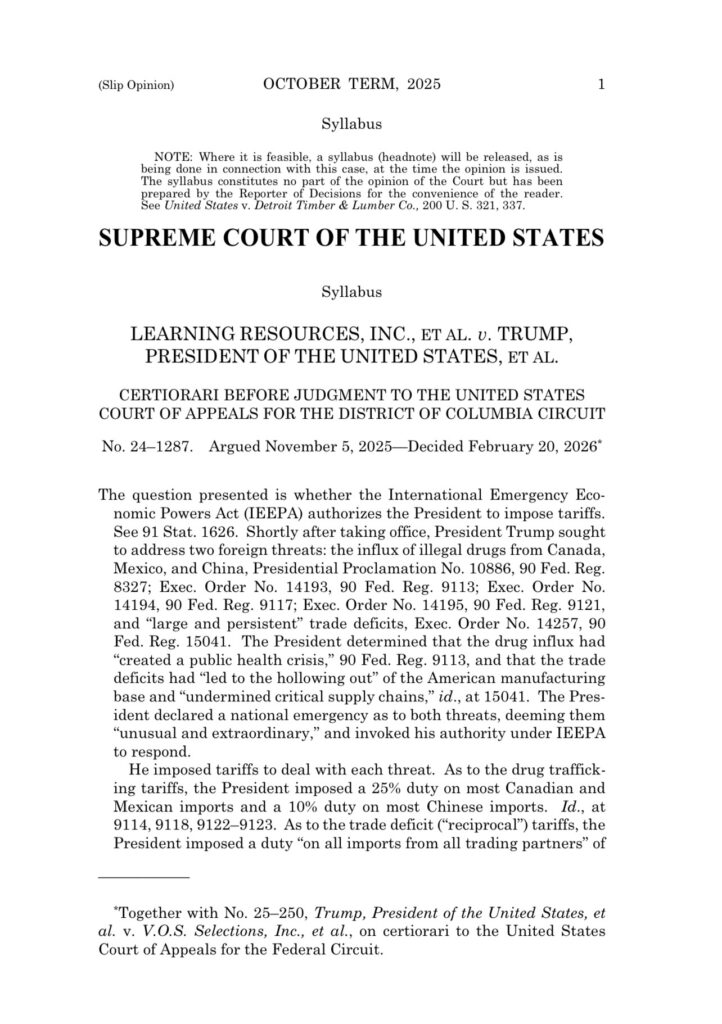
The Court held that the tariffs exceeded presidential authority, as IEEPA does not grant the power to impose such duties, which are reserved for Congress under Article I of the Constitution. The majority applied the major questions doctrine, requiring clear congressional authorization for actions with vast economic significance. This interpretation prevents the executive branch from using ambiguous statutory language to encroach on legislative powers.
Details from the ruling reveal that the tariffs, often described as reciprocal measures against trading partners, were implemented without sufficient legal backing. Over $130 billion to $175 billion has been collected from these tariffs, primarily paid by U.S. importers. However, the opinion does not specify what happens to these funds, leaving open the possibility of refunds to affected companies. Dissenting opinions noted that refunds could create a complex process, potentially returning billions but causing administrative challenges. As of now, the U.S. government is not required to repay the money directly, but importers may seek reimbursements through legal channels, sparking a rush for claims.
For south central Ohio, a region reliant on manufacturing and agriculture, the ruling could bring mixed effects. Trump’s tariffs had a varied impact on the state’s economy. In manufacturing, about one-third of Ohio companies reported sales changes due to the tariffs, with 18 percent experiencing losses averaging 16 percent, compared to 15 percent seeing gains of about 9 percent. Sectors like steel benefited from protection against foreign competition, but metal-using industries, including automotive, faced higher input costs.
Agriculture in Ohio suffered significantly from retaliatory tariffs, particularly on soybeans, the state’s largest crop. Exports to China, a major buyer, dropped sharply, leading to lost markets and lower prices. Farmers received billions in federal bailouts during Trump’s terms to offset these losses, but many described the situation as devastating. The ruling may ease some pressures by halting further tariffs, potentially stabilizing prices and reducing inflation contributions estimated at $1,000 to $1,300 per household annually. However, it could disrupt trade deals and investments, such as a major natural gas facility in Ohio linked to tariff negotiations.
Looking ahead, the decision limits future presidents from unilaterally imposing broad tariffs under IEEPA, emphasizing congressional oversight. Other statutes, like Sections 232 and 301 of trade laws, remain available but require more procedural steps. Economists warn of short-term chaos, including higher prices already embedded in supply chains and uncertainty in global trade. For Ohio, this could mean reduced GDP growth and job impacts in the Ohio River Valley region if disruptions persist.
The Trump administration has signaled intentions to explore alternative authorities to maintain aspects of its trade policy. As the dust settles, Ohio businesses and farmers will watch closely for how this evolves, balancing potential relief against ongoing economic uncertainties.