
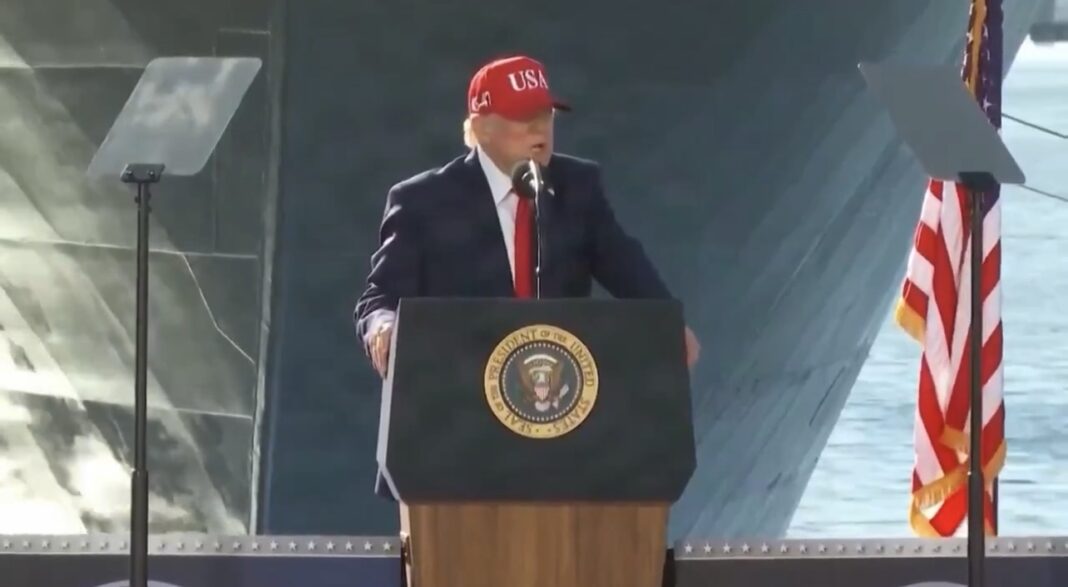

President Donald Trump stood Tuesday at Sparrows Point, outside Baltimore, and sold a familiar idea: put heavy industry back on American water and put people back to work.
The site once belonged to Bethlehem Steel. The mill closed in bankruptcy in 2012. Defense firm Anduril Industries now plans a plant it calls Arsenal-2, backed by a $3.7 billion private investment. The Navy has awarded Anduril a contract of up to $2.9 billion to build parts for Virginia-class attack submarines, including torpedo tubes and doors. Together, the company investment and the Navy contract are valued at up to $6.6 billion.
Trump said the deal would give U.S. taxpayers a 40 percent stake in the shipyard and promised that “the historic grounds of Sparrows Point will never fall silent again.” Anduril says the yard should be operating by the end of the decade, with about 3,100 direct jobs and more than 11,000 indirect jobs once it is at scale. Hiring is expected to start around 2029. Initial operations are aimed at 2030.
That is real steel, real waterfront work, and a real check. It is also not a battleship. The yard is meant to feed the submarine industrial base, not launch a new surface fleet next year. The bill is split between private capital and a Navy purchase contract, and the jobs are years away. For households already stretched, a shipyard ribbon-cutting in another state can look like a distant promise.
The political calendar is not distant. Election Day is Nov. 3.
In Ohio, the numbers have moved against Republicans. A Marist poll of 1,298 registered voters, taken Sept. 24–27, found Democrat Amy Acton leading Republican Vivek Ramaswamy 50 percent to 44 percent in the governor’s race. The same survey put Democrat Sherrod Brown ahead of Republican Sen. Jon Husted, 51 percent to 43 percent. On the generic congressional ballot, Democrats led 50 percent to 47 percent. Trump’s job approval in the poll was 42 percent approve and 56 percent disapprove. The margin of error was plus or minus 3.8 points.
A Suffolk University survey of 500 likely voters, taken Sept. 23–27, was sharper on the governor’s race: Acton 50 percent, Ramaswamy 41 percent, with a margin of error of plus or minus 4.4 points. Earlier surveys were tighter. A Fox News poll in August had Ramaswamy ahead 50 percent to 48 percent. A Bowling Green State University/YouGov poll in early September had Acton up 48 percent to 45 percent. The recent public polls have Acton in front.
Marist also found a sour read on household finances. Forty-one percent of Ohio registered voters said their personal finances had gotten worse in the past year. Thirty-seven percent said they were about the same. Nineteen percent said they had improved. A plurality, 41 percent, said their vote for Congress would mainly be a vote against Trump.
National surveys point the same direction. An NPR/PBS News/Marist poll of registered voters in mid-September had Democrats ahead 53 percent to 41 percent on the generic congressional ballot. Other September averages put the Democratic edge closer to 8 points. Midterm polls move, and Ohio is not the country, but the vibe inside the state is rough for the party in power.
Ramaswamy’s last two weeks have not helped the picture. At a Saturday rally in Vandalia, with Trump in the state, he invited a boy onstage after reading a sign about a deployed father. He told the child he would pick him up, then briefly lost his grip before steadying him. “Whoa,” he said. “Big guy.” The clip spread fast, and the jokes wrote themselves. It was an awkward few seconds, not a policy paper. Campaigns still remember those seconds.
Separate from the video, campaign finance reports show his campaign has spent nearly $690,000 leasing private aircraft. Nearly $560,000 of that went to V Leasing LLC, which lists as its address a house Ramaswamy owns. Federal flight records reviewed this summer showed in-state trips of about 30 minutes, including Columbus to Port Clinton, Cleveland, and Youngstown. A former Brown County Republican Party chairman told reporters Ramaswamy should “park the damn jet.” The campaign has not offered a detailed public defense of the spending in those reports. Nothing in the filings, by itself, establishes a legal violation.
The shipyard is the kind of project both parties say they want: American work, on American ground, tied to a Navy that has been short of submarine capacity for years. Maryland’s Democratic governor, Wes Moore, has backed the project even though he did not appear with Trump. The cost is the other half of the story. Taxpayers are on the hook for a contract worth up to $2.9 billion, with a promised ownership stake whose terms still have to be spelled out, for jobs that will not show up on a paycheck before the next governor is sworn in.
Readers here do not need a lecture on Trump. Some would vote for him twice on the same Tuesday. Some would not cross the street to hear the speech. The fairer point is simpler. A new yard at Sparrows Point is a serious industrial bet. It is also not what most Ohio voters listed first when pollsters asked about their own money, four weeks before they cast a ballot.

Send a tip or correction to info@heritageheadlines.com, or use the contact page.