
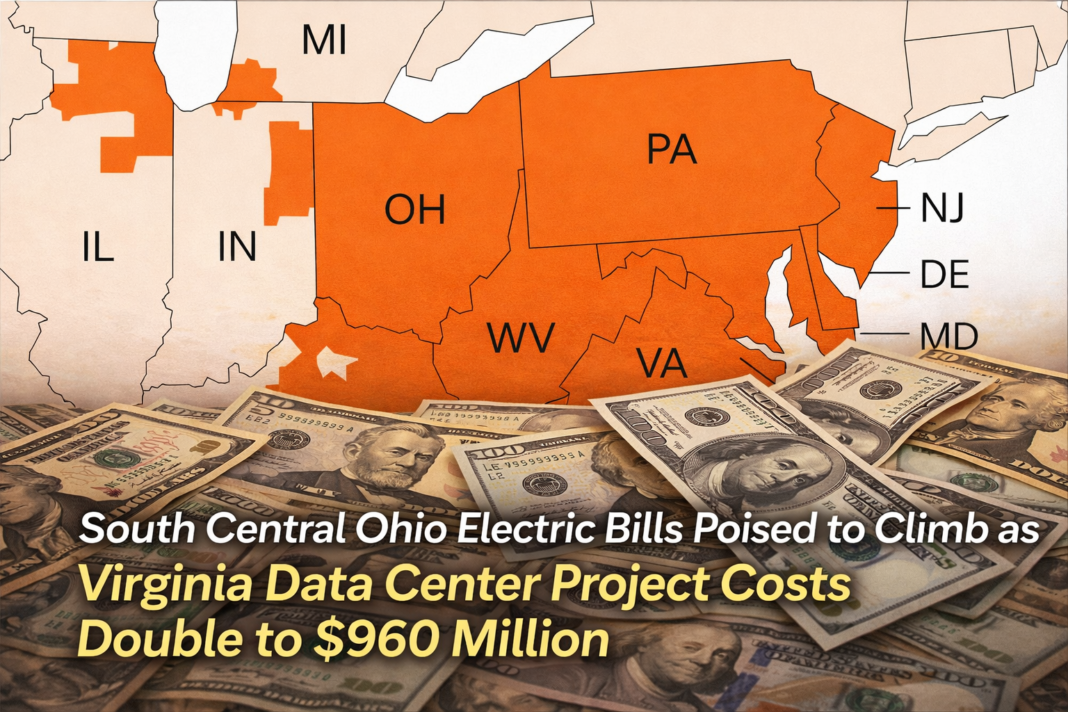
South central Ohio residents could soon see higher electric bills as part of a regional transmission project designed to power data centers in northern Virginia experiences a sharp cost increase.
The Mid-Atlantic Resiliency Link transmission line, approved by the PJM Interconnection in December 2023, would run through parts of Pennsylvania, West Virginia, Maryland and Virginia to deliver electricity to data centers in northern Virginia. NextEra Energy, one of the project developers, updated its cost estimate for its portion of the line from $441 million to $960 million, according to filings reported by the Institute for Energy Economics and Financial Analysis on March 24, 2026.
PJM Interconnection, the regional grid operator serving 13 states and the District of Columbia including Ohio, allocates the costs of approved transmission projects across ratepayers in its footprint. This means customers of utilities such as AEP Ohio and South Central Power Cooperative in south central Ohio will share in the expenses even though the project provides no direct service to the Buckeye State.

The Institute for Energy Economics and Financial Analysis estimates that West Virginia ratepayers alone could bear more than $572 million over the 40-year life of the project, with no local benefit from the line. Similar cost allocation applies region-wide, including to Ohio.
Data centers have driven much of the recent growth in electricity demand across PJM territory. A September 2025 report from the Union of Concerned Scientists found that utilities in seven PJM states, including Ohio, approved more than $4.4 billion in transmission upgrades in 2024 tied specifically to data center connections. Ohio accounted for 37 such projects at a cost of nearly $1.3 billion.
Ohio regulators and utilities have taken steps to address local impacts. AEP Ohio, which serves much of central and southern Ohio, received approval from the Public Utilities Commission of Ohio for a data center tariff that requires large new loads to cover at least 85 percent of their projected energy use to limit the burden on other customers. South Central Power Cooperative has also implemented policies aimed at ensuring data center developers contribute fairly to infrastructure upgrades.
PJM capacity market auctions have reflected the surge in demand. Prices rose dramatically in recent years, contributing to projected residential bill increases of 1.5 percent to 5 percent or more in some cases, according to PJM analyses. Ohio Gov. Mike DeWine joined other governors in urging PJM to address supply-and-demand imbalances driven by large loads such as data centers.
The transmission line still requires approvals from state public utility commissions in the states it traverses. Construction timelines and final cost allocations could shift based on those proceedings and any future PJM reforms to its cost-allocation methods.
For south central Ohio households and businesses already facing upward pressure on rates, the development underscores how regional grid decisions affect local utility bills. Residents can monitor updates through the Public Utilities Commission of Ohio website or their electric cooperative statements for any specific rate adjustments tied to PJM-wide projects.
This situation highlights ongoing debates about who should pay for infrastructure needed to support rapid growth in data centers while protecting residential ratepayers. Ohio utilities continue to balance new large-load connections with efforts to keep service reliable and affordable for all customers.