
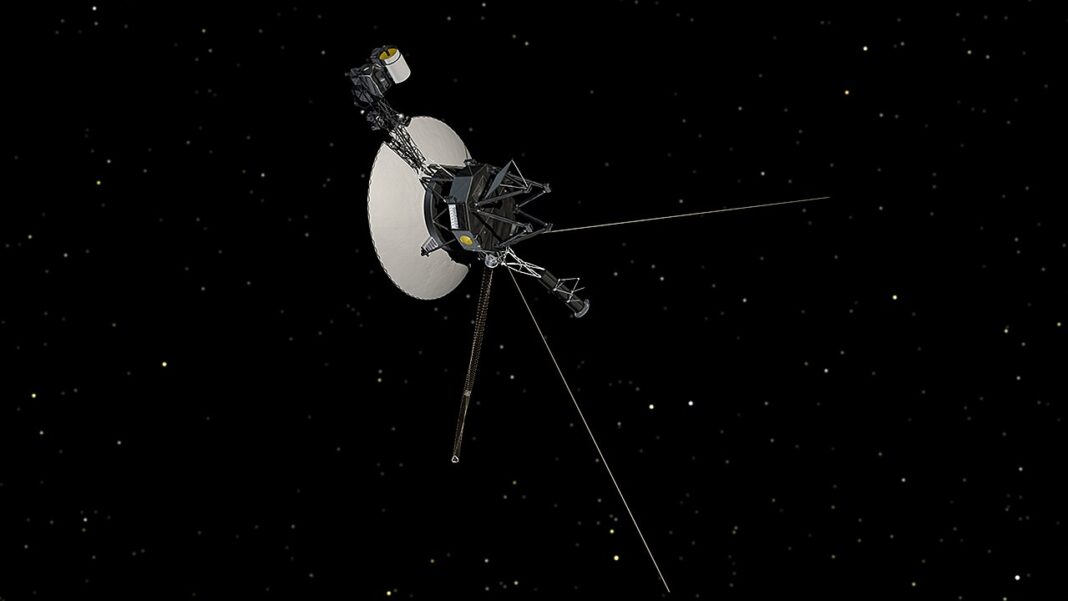

NASA’s Voyager 1 spacecraft crossed a line Wednesday morning that nothing built by human hands has ever crossed. It is now one light-day from Earth, about 16.1 billion miles away, and still flying.
A light-day is the distance light travels in 24 hours. That means a radio signal from Earth, moving at the speed of light, now takes a full day to reach the probe. When NASA sends it a command, the answer takes another day to come back.
NASA says Voyager 1 reached the mark at 5:16 a.m. Eastern time on Nov. 18. The team at NASA’s Jet Propulsion Laboratory in California heard the probe’s carrier signal 24 hours later, early Thursday, right on schedule. Engineers confirmed the milestone using that signal and the spacecraft’s tracked path. The probe has not sent its regular science and engineering data since Nov. 14, but the carrier signal that normally carries that data is still coming through.
The distances are hard to picture. The Moon is about 1.3 light-seconds from Earth, and sunlight takes a little over eight minutes to get here. Voyager 1 is now more than four times farther away than Pluto is from the Sun.
Voyager 1 launched from Cape Canaveral, Florida, on Sept. 5, 1977, a few weeks after its twin, Voyager 2. It flew past Jupiter and Saturn, then kept going. In 2012 it crossed into interstellar space, the region between the stars, and it has been the farthest human-made object since it passed Pioneer 10 in 1998. It still carries the Golden Record, a collection of sounds and pictures from Earth, packed away in case anyone ever finds it.
The probe is traveling at about 38,000 miles per hour. Eight of its ten original instruments no longer work, and its nuclear power source weakens a little every year. Engineers have kept it alive with backup systems and workarounds. In September they finished a power-saving operation the team nicknamed the “Big Bang,” and in October the probe went quiet for about two days before its signal came back on its own.
Linda Spilker, the Voyager project scientist at JPL, said a radio signal sent from Earth “would take exactly 24 hours to reach Voyager 1.” Mission manager Kareem Badaruddin compared talking to the probe to the trickiest long-distance call there is.
Voyager 1 is headed in the direction of a star called Gliese 445. In about 40,000 years, it will pass within 1.7 light-years of that star. Voyager 2 is not expected to reach one light-day until 2035, and by then it likely will not have enough power left to call home. The twin probes will mark 50 years in space next summer.
Voyager 1’s power fades a little more each year, and someday the calls will stop. For now, a machine launched in 1977 is still reporting back, one full day away at the speed of light.
Send a tip or correction to info@heritageheadlines.com.
Get the morning stories.
Send a tip or correction to info@heritageheadlines.com, or use the contact page.
The great Logan Elm stood in which county?
Today's question. Five seconds to vote, all day to argue about it.
Cast your voteLocal trivia and strong opinions, a new question every day. No sign-up, just vote.
Comments
No comments yet. Be the first to weigh in.
You need to be signed in to comment.
Sign in to commentNew here? Create a free account. It only takes a minute.