
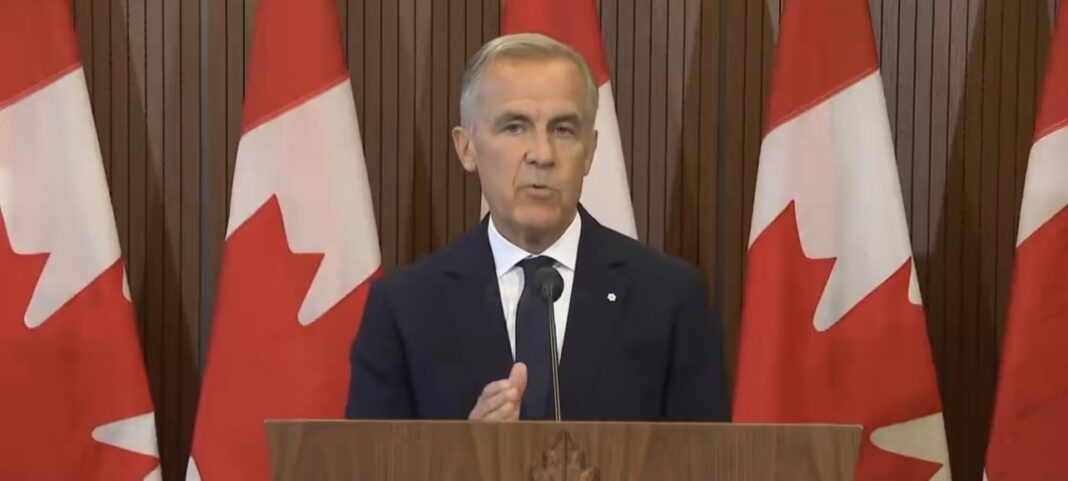

Prime Minister Mark Carney announced Saturday that Canada will impose reciprocal tariffs on U.S. goods after last-minute trade negotiations with Washington failed late Friday. The United States put 50 percent tariffs into effect early Saturday on about $20 billion worth of Canadian products.
Carney suspended talks and recalled Canada’s negotiators from Washington. He said last-minute changes proposed by the U.S. side were unfair and uneconomic and called the reliability of any deal into question. “They asked too much and offered too little,” Carney told Canadians in remarks Saturday in Ottawa.
The new U.S. tariffs, imposed under Section 338 of the Tariff Act of 1930, cover a range of goods including hockey equipment, clothing, cement, wine, plywood, electrical equipment and other items. They apply to roughly 5 percent of Canada’s annual exports to the United States and took effect at 12:01 a.m. ET Saturday after President Donald Trump extended an earlier deadline by three days to allow talks to continue.
Canada will match the tariffs “dollar for dollar” to protect workers and businesses, Carney said. The Canadian measures will focus on sectors such as steel, dairy, appliances, agricultural equipment, pulp and paper, and electronics. They are scheduled to take effect Tuesday after Labour Day, on September 8. Full details of the Canadian list will be released in the coming days.
U.S. Trade Representative Jamieson Greer said Canada declined to finalize a deal under terms discussed earlier in the week. He stated that new Canadian demands and walk-backs of prior commitments upset the balance that had been reached. Greer said the U.S. offer would have given Canada the best treatment of any major exporter to the American market, including reductions on steel, aluminum, autos and lumber.
Both governments blamed the other for eleventh-hour changes. Carney said Canada had been prepared to drop remaining retaliatory tariffs on steel, aluminum and autos if the United States substantially lowered its own duties and to encourage provinces to restore sales of U.S. alcohol. Sovereignty issues, including protections for language and culture, remained off the table, he added.
Asked whether the two countries were in a trade war, Carney replied: “You’re at war when you’re attacked. We got attacked.” He described the U.S. action as a miscalculation designed to hurt and divide Canadians and said Canada took the retaliatory step reluctantly because it will raise costs and reduce choice at home.
The dispute adds to earlier U.S. tariffs on Canadian steel, aluminum, automobiles and lumber. Canada sends about 70 percent of its goods exports to the United States. Analysts have estimated the new 50 percent tariffs could reduce Canadian GDP by 0.3 to 0.6 percent and put tens of thousands of jobs at risk, though the direct hit is limited because the measures cover only a slice of total trade.
Ohio is among the U.S. states most exposed. Canada is Ohio’s largest trading partner, with annual two-way goods trade exceeding $33 billion. Manufacturing and auto-related industries in the state have close supply-chain links across the border. Similar ties exist in Michigan, Indiana and Kentucky.
Carney said Canada will continue building strength at home through major infrastructure projects, housing, tax measures and support for affected workers and firms. The government has already provided nearly $25 billion in assistance over 18 months and plans further help. Ottawa is also accelerating trade diversification with other partners. No new talks with the United States are scheduled.
The collapse marks a further strain in a relationship that both sides have described as fundamentally changed from the closer economic partnership of past decades. The countries exchanged about $880 billion in goods and services last year.
Send a tip or correction to info@heritageheadlines.com.
Get the morning stories.

Send a tip or correction to info@heritageheadlines.com, or use the contact page.