
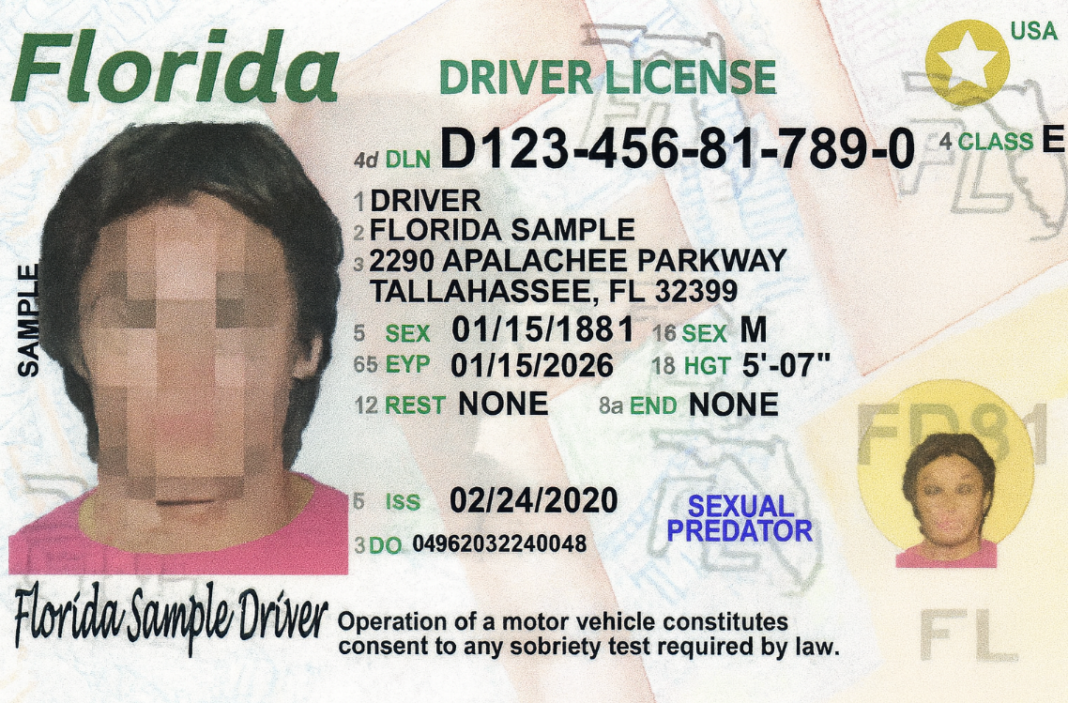

A Florida appeals court has upheld a state law that puts the words “SEXUAL PREDATOR” on the front of certain driver’s licenses and state ID cards. The Florida Supreme Court later declined to take the case. Ohio does not print that kind of label on licenses today, and a search of recent Ohio legislation found no bill that would copy Florida’s approach. Whether Ohio could be next is a policy question, not a pending statute.
What Florida decided
Florida law already required the marking. Under Florida Statute 322.141(3), licenses and ID cards issued or reissued to people designated as sexual predators must carry the words “SEXUAL PREDATOR” on the front. People required to register as sexual offenders receive a different marking: “943.0435, F.S.,” a citation to the offender-registration statute, not the phrase “sex offender.” Career offenders can receive a separate statutory citation.
The fight was over whether the predator wording is constitutional. In January 2025, a three-judge panel of Florida’s Fifth District Court of Appeal said the “SEXUAL PREDATOR” label was compelled speech and was not narrowly tailored. On August 15, 2025, the full court reversed that panel and upheld the requirement in Crist v. State, 419 So. 3d 183 (Fla. 5th DCA 2025).
Judge Jordan Pratt wrote that a reasonable observer would understand the words as the state’s message, just as the state lists a date of birth, height, or eye color. He also wrote that a license is “normally hidden from public view,” so the state is not forcing the holder to display the message on a yard, vehicle, or website.
Judge Scott Makar dissented. He said compelled government speech still has limits and that the label is not the least restrictive way to protect the public. He pointed to Florida’s online registry and neighborhood-notification rules, and to court rulings from Louisiana and Alabama that rejected similar prominent wording on licenses.
The Florida Supreme Court denied discretionary review on January 30, 2026. Counsel for the defendant later sought review in the U.S. Supreme Court. As of public reporting through mid-2026, that petition had not produced a widely reported grant of review. The state-court ruling that keeps Florida’s marking in place remains the controlling result in Florida unless a higher court later says otherwise.
What the case was about
The challenge came from Michael Crist. Court records and contemporaneous reporting state that he pleaded no contest in 2002 to attempted sexual battery on a child under 12 and lewd and lascivious molestation. After his 2008 release he was on supervision in Sumter County and held a license marked “SEXUAL PREDATOR.” In 2019 a probation officer saw him trying to remove a sticker that covered the wording. He was charged with possessing a license that did not display the required marking and with related evidence-tampering. Altering or hiding the marking is a crime under Florida law. Reports described a third-degree felony exposure of up to five years in prison. Crist later remained incarcerated on those later charges.
The legal question was not whether Florida may keep a public sex-offender registry. Florida already does. The question was whether the state may force a person to carry the government’s “SEXUAL PREDATOR” message on a document that must be shown to police, banks, employers, landlords, and others.
Supporters treat the marking as a public-safety tool. Former Florida state Sen. Lauren Book, a child-sexual-abuse prevention advocate, has described the policy as prevention and identification, not extra punishment. Opponents argue it is a lifetime scarlet letter that can block housing, work, and ordinary transactions after the criminal sentence is over, and that existing registries already notify the public.
What this means in practice
In Florida, a person classified as a sexual predator who obtains or renews a license or ID must receive the front-of-card wording. Sexual offenders receive the statute-number marking instead. Covering or altering the required marking can lead to a new felony case. The designation on the card is not time-limited by the license statute itself. It follows the person’s predator status.
A license is shown far more often than a registry website is checked. That is the point of the policy for supporters, and the core objection for critics.
Ohio’s current law is different
Ohio does not require a “SEXUAL PREDATOR,” “SEX OFFENDER,” or similar phrase on a driver’s license or state ID. A 2025 multi-state compilation of registration rules listed Ohio as “No” on labeled state IDs. Ohio Revised Code 4507.13 lists what a license must display: number, name, date of birth, address, photo, physical description, signature, and certain medical or veteran notations. It does not list a sex-offense status. The ID-card statute, R.C. 4507.52, is the same on that point.
Ohio already runs a separate system. Chapter 2950 of the Revised Code is the Sex Offender Registration and Notification (SORN) law. Offenders are classified in Tiers I, II, and III. They must register with the county sheriff, update addresses, and in many cases appear on the attorney general’s public internet registry. Registration forms already collect a driver’s license or state ID number. The Bureau of Criminal Identification and Investigation may share limited information with the registrar of motor vehicles to verify and update records. That is record-matching, not a stamp on the plastic card.
Has Ohio started working on a Florida-style license law?
No public bill located in recent Ohio sessions would add “SEX OFFENDER” or “SEXUAL PREDATOR” to licenses or IDs.
Ohio has tightened other parts of SORN. House Bill 289 of the 135th General Assembly, effective March 20, 2025, addresses registration compliance. Among other changes, it tolls the registration period while an offender is out of compliance and requires a fixed residence address or a detailed description of places the person intends to stay. That bill does not change what is printed on a license. House Bill 102, advanced in the House in late 2025, would expand residency and loitering limits near victims. That is also not a license-marking bill.
Those measures show the General Assembly is still active on sex-offender policy. They do not show a Florida-style license bill in the pipeline.
Could Ohio be next?
It could introduce such a bill. Nothing in Ohio law forbids the legislature from proposing one. “Could they be next?” is not the same as “are they next.”
Several legal limits would matter in Ohio if a bill were filed.
First, the Ohio Constitution, Article II, Section 28, bars retroactive laws. The Ohio Supreme Court held in State v. Williams, 129 Ohio St.3d 344, 2011-Ohio-3374, that Ohio’s Adam Walsh Act registration scheme is punitive and cannot be applied to people whose offenses occurred before January 1, 2008. A new license-face label applied to older cases would invite the same retroactivity fight, especially if courts treat the label as punishment rather than a civil notice.
Second, a First Amendment compelled-speech claim would be expected. That is the claim Florida’s full appeals court rejected and that courts in Louisiana and Alabama accepted in similar fights. The U.S. Supreme Court’s decision in Wooley v. Maynard (1977) blocked New Hampshire from forcing drivers to display “Live Free or Die” on license plates. Florida’s majority said a hidden ID card is different from a bumper message. A future Ohio court would have to decide which analogy fits.
Third, Ohio already publishes registry information online and notifies communities for higher-tier offenders. Any new bill would have to explain why the existing registry, sheriff registration, and vehicle-plate data already collected at registration are not enough. That is a legislative choice. It is also the question courts ask when they apply narrow-tailoring analysis.
Other states offer mixed models. Compilations used by supervision professionals have listed Florida, Kansas, Mississippi, and Oklahoma among jurisdictions with some form of labeled ID. Delaware, West Virginia, Tennessee, Alabama, and Arizona have used codes or law-enforcement-only designations rather than large public wording. Louisiana’s prominent “sex offender” lettering drew a state supreme court rejection; later legislation there shifted toward tools such as a QR code for law enforcement. South Carolina lawmakers filed a 2025 bill to print “Sex Offender” in red on certain licenses. Those examples show interest in the idea. They also show court pushback when the wording is large and public.
Bottom line for Ohio readers
Florida’s current rule is: sexual predators keep the words “SEXUAL PREDATOR” on the front of a license or ID, and the state’s highest court declined to undo that result. Ohio’s current rule is: no such wording on the card, plus a public registry and sheriff registration. Recent Ohio bills have tightened how people register and where they may live. They have not copied Florida’s license stamp.
If Ohio lawmakers propose a similar marking, the debate would not start from a blank page. It would start from Ohio’s retroactivity clause, Williams, the First Amendment cases already fought in Florida, Louisiana, and Alabama, and the registry Ohio already maintains. Until a bill is introduced, “next” is speculation, not law.
Send a tip or correction to info@heritageheadlines.com.
Get the morning stories.

Send a tip or correction to info@heritageheadlines.com, or use the contact page.