
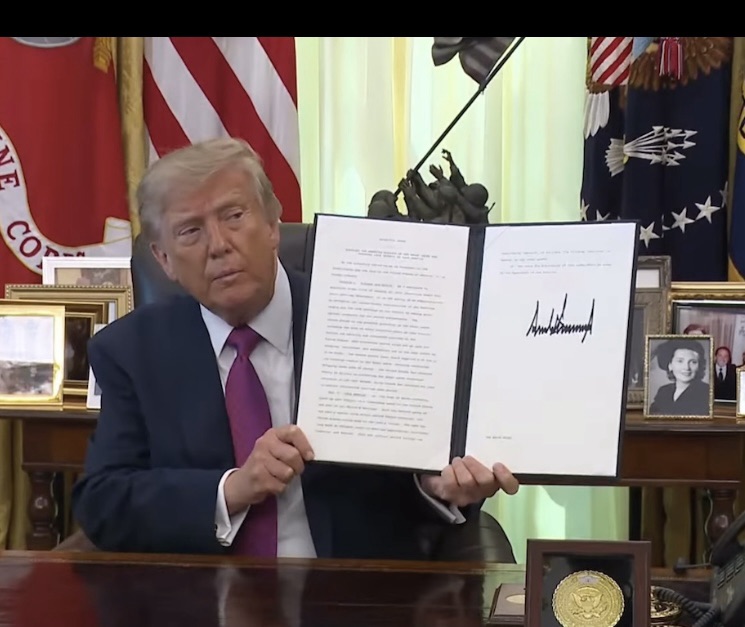

WASHINGTON — President Donald Trump signed an executive order Thursday directing the U.S. government to call Lake Ontario “Lake America.” He signed the document in the Oval Office and said the change was “official, effective immediately.”
The order, identified in White House materials as Executive Order 14420, instructs Interior Secretary Doug Burgum and the U.S. Board on Geographic Names to update the Geographic Names Information System within 30 days. Federal agencies would then use “Lake America” in official maps, documents, and communications.
The order does not rewrite Canadian law, international charts, or New York state signs. It also does not change the physical lake or the U.S.-Canada border. Canada has already said it will keep the historic name. Industry Minister Mélanie Joly said earlier this week: “We’ll always call it Lake Ontario. Period.” Prime Minister Mark Carney’s office did not immediately comment Thursday.
What Trump said
Maps of the Great Lakes stood behind the president. One labeled the water “Lake America.” Another carried the slogan “MAKING THE GREAT LAKES EVEN GREATER.”
Trump said the idea had been on his mind “for a long time.” He tied it to his 2025 directive that federal agencies use “Gulf of America” for the Gulf of Mexico.
“We have a gulf and we have a lake,” he said. “Now, all we need is an ocean. So, maybe we’ll have to change the name of the Atlantic and/or the Pacific. Maybe we’ll change them both.”
Asked whether the rename was a message to Canada, he said it was not. “Canada has been ripping us off for a long time on trade,” he said. He also said Canadian officials “have treated us very badly” and called them “the worst to deal with on trade.”
What the order claims
The text says the United States is “the greatest protector of the Great Lakes.” It states that “the deepest parts of the Lake’s waters lying within United States territory” support a U.S. claim to “most of the Lake’s volume.” A White House aide repeated that volume claim at the signing.
Reporting on the lake’s surface area puts about 47 percent on the U.S. side. Lake Ontario is the smallest of the five Great Lakes by surface area, at about 7,340 square miles. It borders New York and the Canadian province of Ontario. A small part of its drainage basin reaches Pennsylvania. It does not touch Ohio. Ohio’s Great Lakes shoreline is on Lake Erie.
The name Ontario comes from Iroquoian languages and is commonly translated as “beautiful lake” or “lake of shining waters.” Versions of the name appear on European maps from the 1600s, long before either modern country took its present form.
Why this is happening now
U.S.-Canada trade talks collapsed late last week. The United States then imposed 50 percent tariffs on about $20 billion in Canadian goods. Canada announced retaliatory tariffs. Trump had posted for days that Washington was considering the rename and that the United States did not expect to do “much business with Ontario any longer.”
The move follows the same pattern as the Gulf of America order. Federal agencies can be required to use a new name. Other countries and private mapmakers are not required to follow. Mexico rejected the gulf rename. Much of the world still uses Gulf of Mexico.
Canadian maritime lawyer Marc Isaacs told NBC News that neither government owns exclusive naming rights to the shared lake. “The Americans can call it whatever they want to call it,” he said. “It is Lake Ontario.”
What this means in Ohio
Ohio has no legal power to name or rename Lake Ontario. A federal naming order does not change Ohio property law, shipping rules on Lake Erie, or the state’s role in Great Lakes compact issues. Readers in Toledo, Cleveland, and other Lake Erie communities may feel the larger U.S.-Canada trade fight through ports, steel, autos, and tourism. That economic story is separate from the name printed on a federal map of a different lake.
Send a tip or correction to info@heritageheadlines.com.
Get the morning stories.

Send a tip or correction to info@heritageheadlines.com, or use the contact page.