
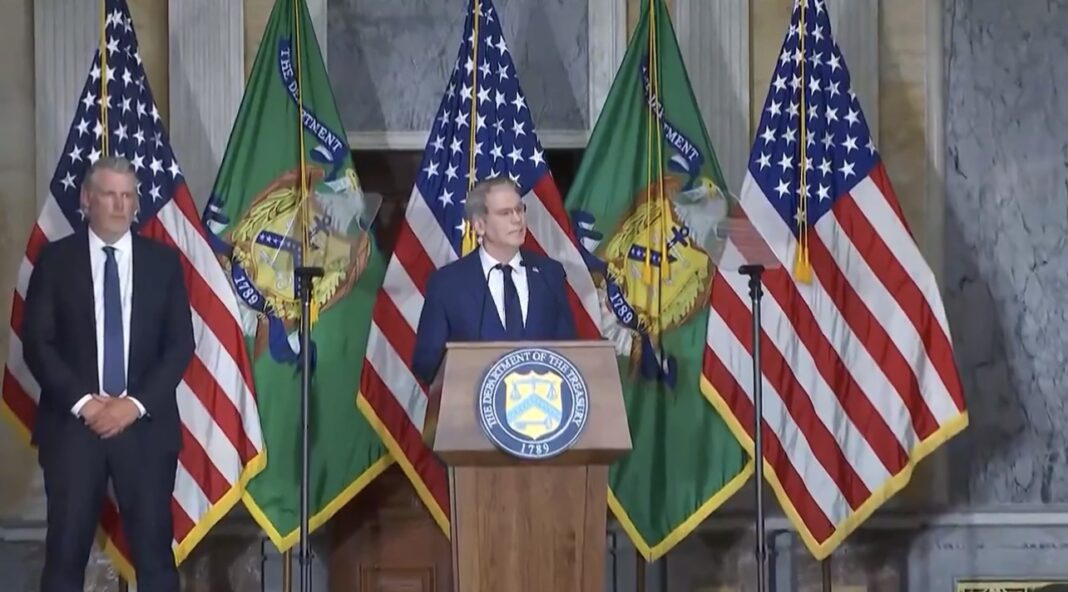

WASHINGTON — Treasury Secretary Scott Bessent on Monday announced Operation Economic Outcast, a campaign the Trump administration says is meant to isolate Iran from remaining global financial and commercial networks as the U.S.-Iran war nears the six-month mark.
Speaking at the Treasury Department, Bessent said the effort was launched at President Donald Trump’s direction. He described it as an “unprecedented campaign against the Islamic Republic of Iran and its enablers.”
“We are launching an economic onslaught against Iran’s financial connections around the globe,” Bessent said. “Our objective is to sever every economic lifeline that sustains this tyrannical regime until Tehran stands alone.”
The administration had previewed the move as an “economic D-Day.” Monday’s announcement expanded secondary-sanctions authority and added new designations, but it stopped short of immediately cutting major foreign banks off from the U.S. dollar system. Bessent said countries would get a “cure period” to end identified activity before the United States acted unilaterally.
What the Treasury announced
Bessent said the department had “mapped every node, every facilitator, and every network that Iran has used to smuggle oil and evade sanctions.” He said Treasury and other agencies would now “tighten the noose and block every potential source of revenue that funds the IRGC and the Iranian regime.”
According to his remarks and subsequent reporting from the Treasury’s announcement:
• New sectoral determinations cover five areas Treasury described as Iran’s remaining lifelines abroad: digital assets, technology, gold, aviation, and shipping. Those determinations broaden the conduct that can trigger secondary sanctions.
• The Office of Foreign Assets Control is designating more than 60 entities, individuals, and vessels that Treasury says help Iran obtain nuclear and missile technology, conduct cyber operations, or generate oil revenue. Reuters reported that the new designations include businesses in China, the United Arab Emirates, Singapore, and other countries.
• Bessent said every branch of Bank Melli, Iran’s state-owned bank, “must be shuttered.”
• He said any entity that facilitates money laundering for Iran “will be removed from the U.S. dollar system.”
• Politico reported that Treasury also ended certain remaining exemptions that had allowed remittance payments into Iran and some Iranian access to U.S. cultural and academic institutions.
Bessent said President Trump was calling foreign leaders with “specific requests” to cut economic ties with Tehran. Teams from Treasury, the State Department, and the Pentagon are meeting counterparts overseas, he said, and every country has been given a “defined timeline” to shut down identified activity. “If they do not take action, we will do so unilaterally through Treasury authorities,” he said.
He declined to name specific countries or banks that would be next. Asked about Chinese institutions that buy Iranian oil or process related payments, he said, “No one is above the reach of U.S. sanctions.” He also said he expected a “major announcement” involving a financial institution by the end of the week.
On why the United States was not imposing the broadest penalties immediately, Bessent told reporters: “Why would I want to blow up the global financial system? We believe that it is important to level set and give people a cure period, but they should know that that will move very quickly and that we are serious.”
He added that the campaign “will not end until this regime stands alone” and that the United States does not have “infinite patience.”
Context of the war
The announcement comes as the conflict that began in late February 2026 enters its sixth month. Reporting from Reuters, CBS News, and other outlets describes a naval blockade of Iranian ports, continued disruption in the Strait of Hormuz, elevated energy prices, and stalled diplomacy. Heavy fighting has eased in recent weeks, but a political settlement has not taken hold.
The administration previously rolled out a pressure campaign known as Operation Economic Fury. Bessent has argued that military action plus financial isolation can force a change in Tehran. Iran has lived under U.S. and international sanctions for decades and has repeatedly used front companies, a “shadow fleet” of tankers, and alternative payment channels to sell oil.
Iran’s response
Iranian officials dismissed the announcement and warned other countries not to join it.
Deputy Foreign Minister Kazem Gharibabadi said U.S. claims that Iran’s military and nuclear programs had already been destroyed did not match the decision to launch “the largest financial offensive in history.” He called the new campaign an admission of American failure.
Mohsen Rezaei, secretary of Iran’s Supreme National Security Council, had already warned that if the “economic war continues,” Iran would halt oil exports through the Strait of Hormuz and the Persian Gulf and treat participating countries as parties to the conflict. Foreign Ministry spokesman Esmaeil Baqaei said countries that take part would face “consequences.”
Iran’s central bank governor, speaking to Tasnim before the press conference, said the latest U.S. claims did not add new restrictions beyond measures already in place and that Tehran had stockpiled foreign currency for essential goods.
What remains unclear
Monday’s package is a mix of new legal authorities, additional designations, and a public warning to third countries. It is not, by Bessent’s own description, an immediate cutoff of every major bank that still touches Iranian oil trade.
Markets showed little immediate reaction to the remarks, according to NBC News. Energy prices have already been elevated by the blockade and the risk of further disruption in the Gulf.
Whether Operation Economic Outcast produces a diplomatic opening, a sharper clash with China or other buyers of Iranian crude, or simply another layer of sanctions on an already isolated economy will depend on how quickly Treasury follows the warning with enforcement, and how Tehran and its remaining commercial partners respond.
Send a tip or correction to info@heritageheadlines.com.
Get the morning stories.

Send a tip or correction to info@heritageheadlines.com, or use the contact page.